Throughout his professional life, his voice was far more than a means of communication. It was a tool for sharing knowledge, connecting with others, and making a difference. As a hospital physician, teacher, journalist, radio contributor, and audiovisual producer, Pierre Lemaire spent decades informing, explaining, and making complex medical topics accessible to a wide audience.
But when he lost his voice following a laryngectomy, an essential part of his identity disappeared. My-Own-Voice, a solution developed by Acapela Group, a speech technology company based in Mons, Belgium, enabled him to speak once again.
This is a story where innovation, artificial intelligence, and human resilience come together to show that today, losing your voice no longer necessarily means losing your ability to express yourself.
At the beginning of 2026, Professor Sonia Hammami invited him once again to speak at the 7th National Congress of Geriatrics and the 6th Euro MedGeriatric Meeting in Tunisia.
With more than 650 participants, the event has become a major gathering for specialists in geriatrics and aging medicine. For Pierre Lemaire, the invitation carried special meaning, as he had been a regular contributor to the congress for several years. He agreed to deliver three presentations.
A question immediately came to mind: how do you continue to share knowledge and connect with others when you can no longer speak?
This question led him to explore speech synthesis technologies.
How can you address an audience of several hundred people when you have lost your voice?
Initially, he prepared his presentations using a standard synthetic voice. The solution was effective, but it lacked personality.
He then got in touch with Acapela Group. The company, like Pierre, is based in Mons and was already familiar to him. Years earlier, he produced a documentary about the company as part of his audiovisual work. What began as a local connection soon became something much more personal.
For over a decade, Acapela has been developing My-Own-Voice, a solution that enables people who have lost their voice to continue communicating through a personalized synthetic voice. Using a limited number of recordings, the technology can recreate a digital version that closely matches the original voice.
Under normal circumstances, creating a personalized synthetic voice requires the person to record a set of sentences used to train the voice model.
However, when this process was not completed before the loss of voice, My-Own-Voice can rely on existing audio archives to recreate a personalized voice.
The alternative consists of using recordings that already exist—provided they are of sufficient quality—to reconstruct a digital voice that faithfully reflects the individual. This approach opens new possibilities not only for people affected by head and neck cancers, but also for those living with neurological or degenerative conditions that affect speech.
Thanks to the extensive audio archives generated through his work in radio, education, and audiovisual production, Pierre Lemaire had exactly the material needed to recreate his voice. A few days after submitting his recordings, he received the first sample. The emotion was immediate. He heard his own voice again—its intonations, rhythm, and identity.
The collaboration with Acapela Group soon took shape through the three presentations that would be delivered using a digital version of his own voice.
Following a long absence due to illness, he was able to reconnect with a congress that meant so much to him.
A memorable moment at the congress
The congress opened in a particularly vibrant atmosphere, driven by high-level presentations and scientific exchanges. It was in this context that Pierre Lemaire took the stage.
When his presentation began, a clear and familiar voice resonated throughout the room. His voice.
The emotional impact was immediate, especially for those who had known him for many years and instantly recognized his distinctive intonations.
At the end of his first presentation, the audience rose to its feet for a long standing ovation.
Beyond the technological achievement, participants discovered how innovation can help preserve something deeply personal: an individual’s identity.
AI Technology with a human purpose
Pierre Lemaire’s presentation will remain one of the highlights of this edition of the congress, powerfully illustrating the connection between innovation, medicine, and quality of life.
His experience shows that artificial intelligence reaches its full potential when it is used in service of people.
Hope for others facing voice loss
This story goes far beyond technology. It sends a powerful message that today’s technologies can help many people facing speech loss preserve an essential part of their identity.
The ability to recreate a voice from existing audio archives represents a major breakthrough for people who did not have the opportunity to anticipate voice loss or whose health condition no longer allows them to make the recordings traditionally required for voice banking. Losing your voice no longer necessarily means losing your ability to express yourself.
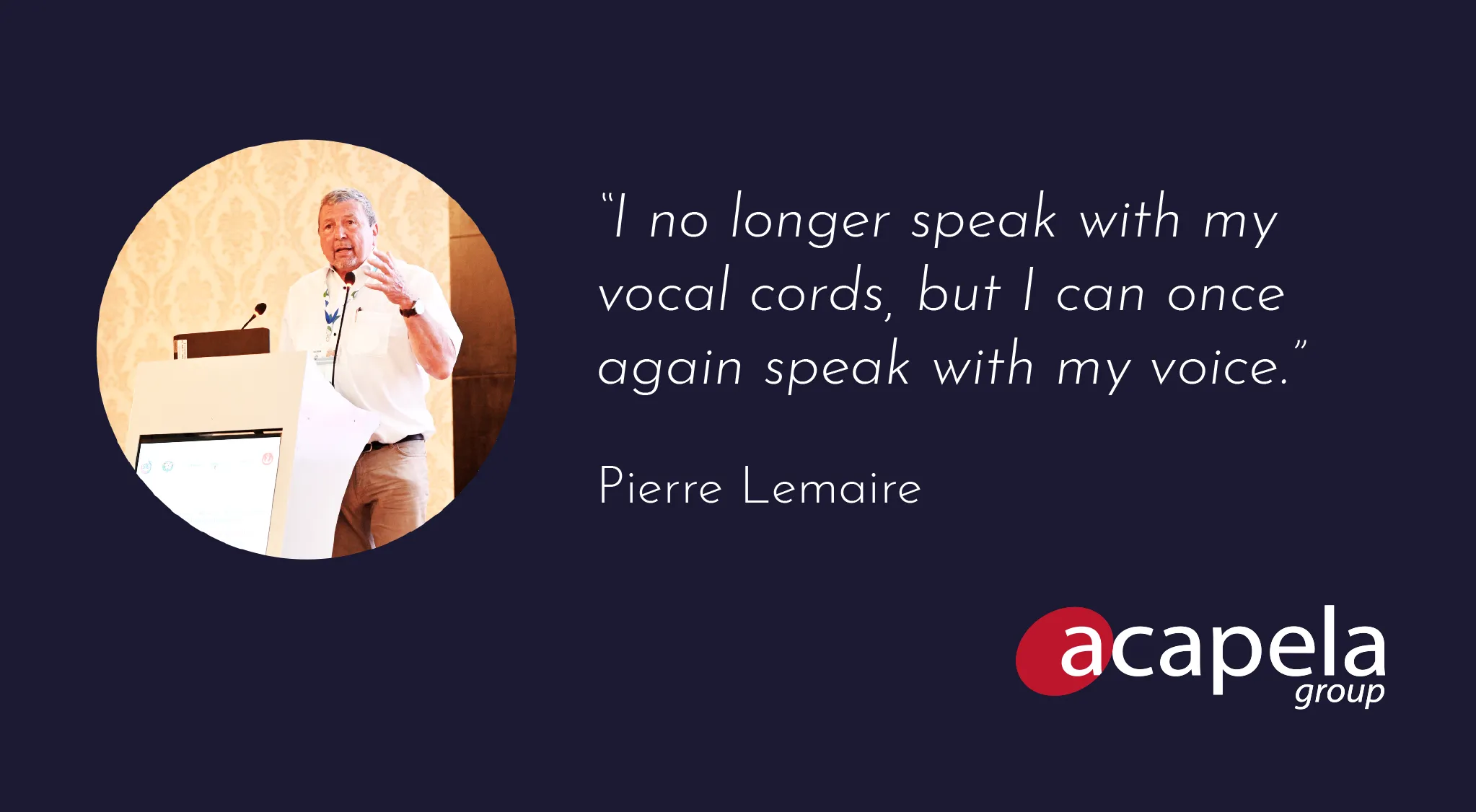
As Pierre Lemaire puts it: “I no longer speak with my vocal cords, but I can once again speak with my voice.”
His journey carries a simple message: solutions exist. They not only restore a way of speaking, but also preserve an essential part of a person’s identity and enable them to continue being heard.
Listen to an excerpt from Pierre Lemaire's talk
-
Pierre Lemaire -extrait avec My-Own-Voice
00:00 / 00:00
Aktuellste Nachrichten
News

A Personalized Voice for Everyone: Acapela My-Own-Voice Now Available to Tobii Dynavox Users at No Additional Cost
News
What If a Voice Could Grow Up?
News
Arabic AI : Rediscover Leila, Acapela’s AI-enhanced Arabic voice
News